
Islamabad & Rawalpindi · Skin & Aesthetics
Your skin looks tired even when you are not, and Islamabad’s dust and Rawalpindi’s humid summers are not making it easier.
What this guide covers
- What Is a HydraFacial, Exactly?
- Why Local Skin Faces a Tougher Fight
- How Does a HydraFacial Session Work?
- When Will You Actually See Results?
- Matching the Treatment to Your Skin Concern
- HydraFacial vs Other Popular Facial Treatments
- Who Should Pause or Modify Treatment
- How to Choose a HydraFacial Islamabad or Rawalpindi Provider
- Frequently Asked Questions
Key Takeaways
- A HydraFacial cleanses, extracts, and hydrates in one pass, with no downtime and no peeling.
- Islamabad’s UV exposure and Rawalpindi’s humidity swings put extra strain on the skin barrier, so aftercare matters as much as the treatment itself.
- Most Pakistani skin tones sit in Fitzpatrick types III to V, which carries a higher risk of dark marks after aggressive treatments, so acid and booster choice needs care.
- One session gives glow. Changing texture, pigmentation, or acne needs a short series, usually three to six sessions spaced two to four weeks apart.
- Not everyone should book immediately. Active breakouts, recent retinoid use, and sunburned skin all call for a short delay.
- Ask any clinic whether they use a genuine HydraFacial MD device, who performs the treatment, and whether a physician reviews the skin plan.
You wash your face every night. You use sunscreen most days. And your skin still looks dull by Thursday.
That is not a discipline problem. It is an environment problem. Islamabad’s dry winters strip moisture fast, and Rawalpindi’s humid months push oil production into overdrive, and both cities sit under enough dust and traffic pollution to leave pores clogged within a day of stepping outside.
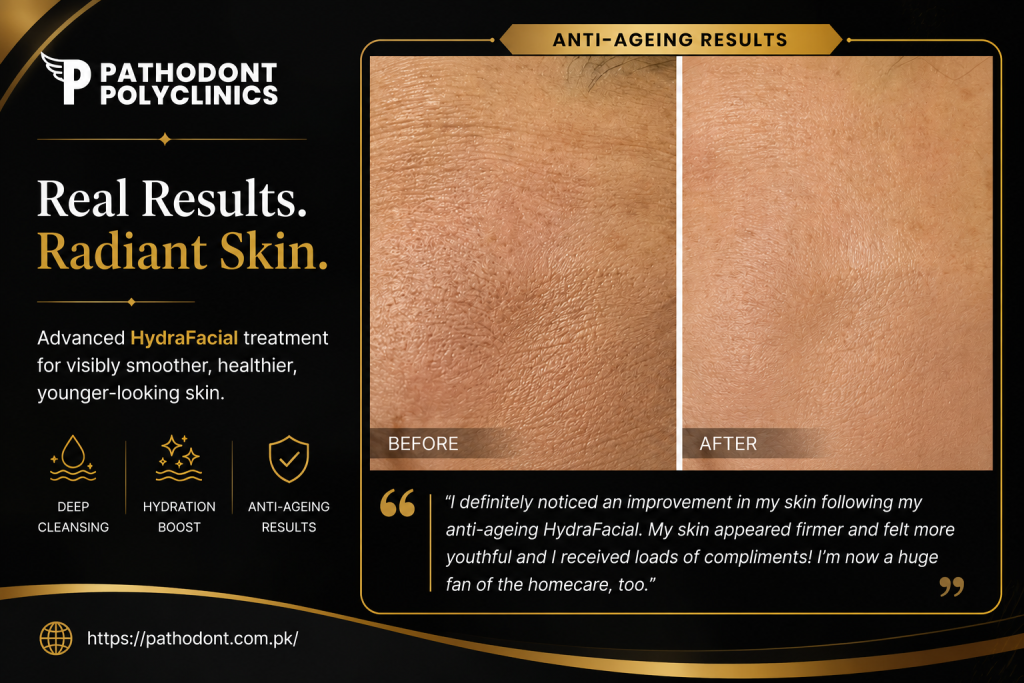
HydraFacial Islamabad clinics are easy to find, but not all of them run the treatment the same way. A HydraFacial is built for exactly this kind of skin stress. It is not a spa treat. It is a short, no-downtime session that cleans, extracts, and hydrates in one pass, and at Pathodont’s HydraFacial treatment in Islamabad, it is paired with a proper skin assessment first.
This guide walks through what the treatment actually does, what results look like on a realistic timeline, who should hold off, and how to tell a genuine provider from a generic aqua-peel copy. No inflated numbers. No guaranteed outcomes. Just what actually happens under the device.
What Is a HydraFacial, Exactly?
A HydraFacial is a medical-grade skin treatment that cleanses, exfoliates, extracts, and hydrates in one continuous pass, using a vortex-tip device instead of manual squeezing. It falls under a category dermatologists call hydradermabrasion. Unlike a peel or microdermabrasion, every step happens through one machine, and you walk out with no redness or peeling.
The device uses a spiral tip that lifts debris out of the pore with gentle suction while it delivers serum at the same time. This is different from a standard facial, where cleansing, extraction, and product application happen as three separate manual steps, each dependent on the esthetician’s hand pressure and technique.
A 2008 peer-reviewed clinical study on the hydradermabrasion device measured thicker epidermal and dermal layers, higher skin antioxidant levels, and reduced fine lines and pore size after a series of treatments, compared with the same serum applied by hand alone. That gap between machine delivery and manual application is the whole point of the technology.
Why Local Skin Faces a Tougher Fight
Islamabad and Rawalpindi combine dry winters, humid summers, and rising particulate pollution, and all three stress the skin barrier in different ways. Add UV exposure that builds up daily, even on cloudy days, since UVA rays pass through window glass and cloud cover alike. The result is skin that looks dull, congested, or blotchy well before visible aging sets in.
The American Academy of Dermatology is clear that ultraviolet exposure accumulates over years and drives premature wrinkling and pigmentation, not just sunburn. Sunscreen helps, but most people apply too little, too late, or skip it entirely on overcast days.
There is a second local factor that generic skincare advice usually skips. Most Pakistani skin sits in Fitzpatrick skin types III through V, meaning it tans and holds pigment more readily than lighter skin types. That is not a downside on its own, but clinical literature confirms it does mean this skin is more prone to post-inflammatory hyperpigmentation, the dark marks left behind after acne, irritation, or an overly aggressive treatment.
This is why a generic, one-size-fits-all facial protocol imported from a lighter-skinned market can backfire here. The right approach adjusts acid strength and booster choice to the person in the chair, not the marketing copy on the machine.
If you have Fitzpatrick type IV or V skin and are prone to dark marks after breakouts, ask your provider to use lactic acid instead of glycolic acid during your session. It exfoliates just as effectively with a lower irritation risk.
How Does a HydraFacial Session Work?
A session runs 30 to 60 minutes and moves through cleansing, gentle exfoliation, painless vortex extraction, and hydration infusion, finishing with LED light or a targeted booster and sunscreen. There is no numbing, no recovery time, and you can return to work or wear makeup the same day.
The Three-Phase HydraFacial Process
Every tier follows this same core sequence. Higher tiers add boosters, LED, and lymphatic drainage on top.
Consultation happens first, every time. Your esthetician checks your skin type and current concerns before choosing acid strength, booster, and whether LED therapy fits your session. This is the step most home devices and budget clinics skip, and it is the step that prevents irritation afterward.
When Will You Actually See Results?
Hydration and glow are visible immediately after your first session. Pore size and texture continue to refine over the following days. Pigmentation, acne marks, and firmness need a short series, typically three to six sessions spaced two to four weeks apart, since these changes happen at a deeper skin layer than a single pass can reach.
A Realistic Results Timeline
Set your expectations by what is actually changing, not just what you see in the mirror that evening.
A single session will not erase deep acne scarring or long-standing melasma. For those concerns, HydraFacial works best as a maintenance layer alongside a targeted treatment such as microneedling, and your provider should say so plainly instead of overselling one machine as a fix for everything.
Matching the Treatment to Your Skin Concern
HydraFacial is not a single fixed treatment. The base steps stay the same, but the acid strength and booster change depending on what your skin actually needs, which is why the consultation step matters more than the marketing tier you book.
Common Concerns and How the Session Adapts
Four concerns we see most often at our Islamabad and Rawalpindi locations.
Acne and oily skin
Salicylic-forward cleansing and a clarifying booster target clogged pores without the inflammation that manual extraction often causes.
Pigmentation and uneven tone
A brightening booster with vitamin C or niacinamide is layered in, paired with strict SPF guidance given the local pigmentation risk.
Sensitive or reactive skin
Lactic acid replaces stronger acids, boosters are limited, and the session focuses on hydration and barrier support over aggressive exfoliation.
Fine lines and early aging
A peptide booster and LED light add collagen-supporting steps on top of the base hydration for early signs of firmness loss.
HydraFacial vs Other Popular Facial Treatments
HydraFacial differs from a chemical peel, microdermabrasion, or photofacial in mechanism, downtime, and how the results build over time. A peel resurfaces with acid strength, microdermabrasion abrades with crystals or a diamond tip, and a photofacial uses light energy on pigment. HydraFacial is the only one of the four that cleanses, extracts, and hydrates in a single pass with no recovery period.
| HydraFacial | Chemical Peel | Microdermabrasion | |
|---|---|---|---|
| Mechanism | Vortex suction plus infusion | Acid resurfacing | Abrasive exfoliation |
| Downtime | None | 2 to 7 days peeling | Mild redness, 1 to 2 days |
| Comfort | Cool, gentle suction | Tingling to stinging | Mild scratching sensation |
| Best for | Hydration, maintenance, prep | Deeper pigmentation, texture | Surface dullness, mild texture |
Neither option is universally better. A peel goes deeper for stubborn pigmentation. HydraFacial wins on comfort, zero downtime, and how well it fits into a routine the week of an event. Most experienced providers combine treatments over time rather than picking one forever.
Who Should Pause or Modify Treatment?
Active cystic acne, current retinoid or isotretinoin use, sunburned or broken skin, an active cold sore, and an uncontrolled rosacea flare all call for a delay or a modified protocol. Pregnancy in the first trimester is another reason to wait and consult a doctor first, and boosters are generally avoided even after that point.
None of this means HydraFacial is unsafe. It means the treatment should be tailored, and a provider who skips this conversation entirely is skipping a step that matters.
Booking a HydraFacial the same week as an aggressive at-home peel or right before heavy sun exposure. Both push already-stressed skin further, and Fitzpatrick types III to V carry a real risk of post-inflammatory dark marks when skin is over-treated.
How to Choose a HydraFacial Islamabad or Rawalpindi Provider
Ask whether the clinic uses a genuine HydraFacial MD device or a generic aqua-peel machine, who performs the treatment and what their certification is, and whether a physician reviews the skin plan for medical concerns like active acne or pigmentation disorders. Transparent pricing and visible hygiene practices, like single-use tips, are the other two markers worth checking before you book.
A quick way to sort real providers from copycats is to ask directly: is this the HydraFacial MD system, or a similar-sounding device? Genuine machines carry a recognizable serial and branding, and a provider confident in their equipment will answer without hesitation.
Before your first visit anywhere, ask to see the esthetician’s certification and whether a dermatologist or physician is involved in reviewing skin plans. You can check Pathodont’s clinical team credentials as an example of what that should look like.
At Pathodont, this is built into how we run both clinics. You can read more about our approach to combined dental and aesthetic care on our about page, or go straight to book a HydraFacial consultation in Islamabad or Rawalpindi if you already know what you are looking for.
Frequently Asked Questions
Does a HydraFacial hurt?
No. Most people describe it as a cool, gentle suction with no stinging or burning. There is no numbing cream involved because none is needed. Some clients feel mild tingling if a stronger booster is used, but this passes quickly and does not carry into the rest of the day.
How often should you get a HydraFacial?
Monthly sessions work well for general maintenance and glow. For active concerns like acne or pigmentation, a short series of three to six sessions spaced two to four weeks apart produces more noticeable change, after which most people shift to a monthly upkeep schedule.
Can HydraFacial help with acne scars?
It can soften mild texture irregularities and post-acne redness through exfoliation and hydration, but it does not resolve deep or ice-pick scarring on its own. For significant scarring, it works best alongside a dedicated treatment such as microneedling, layered in over time rather than as a single fix.
Is HydraFacial safe for sensitive skin or rosacea?
It can be, with adjustments. Providers typically switch to a gentler acid, skip stronger boosters, and focus the session on hydration rather than exfoliation. Active rosacea flares are usually a reason to wait until skin has calmed, so flag this during your consultation before the session begins.
Can you wear makeup after a HydraFacial?
Yes, and many people do the same day since there is no peeling or visible downtime. Most providers recommend waiting a few hours to let the serums fully absorb, and applying broad-spectrum sunscreen underneath makeup if you are heading back out into the sun.
Is HydraFacial safe during pregnancy?
Many providers offer a modified version after the first trimester, using a basic cleanse and hydrate protocol without stronger acids or boosters. This is a decision to make with your obstetrician first, not something to assume is automatically safe just because the base treatment is gentle.
How is HydraFacial different from an at-home facial device?
At-home devices lack the suction power and serum delivery precision of a clinical HydraFacial MD system, and they cannot safely perform true extraction. They can support your routine between sessions, but they are not a substitute for the assessment and adjustment a trained esthetician provides in clinic.
Ready for Skin That Actually Holds Its Glow?
Book a consultation at Pathodont’s Islamabad or Rawalpindi clinic and get a treatment plan built around your skin, not a generic package.
Book Your Consultation →